




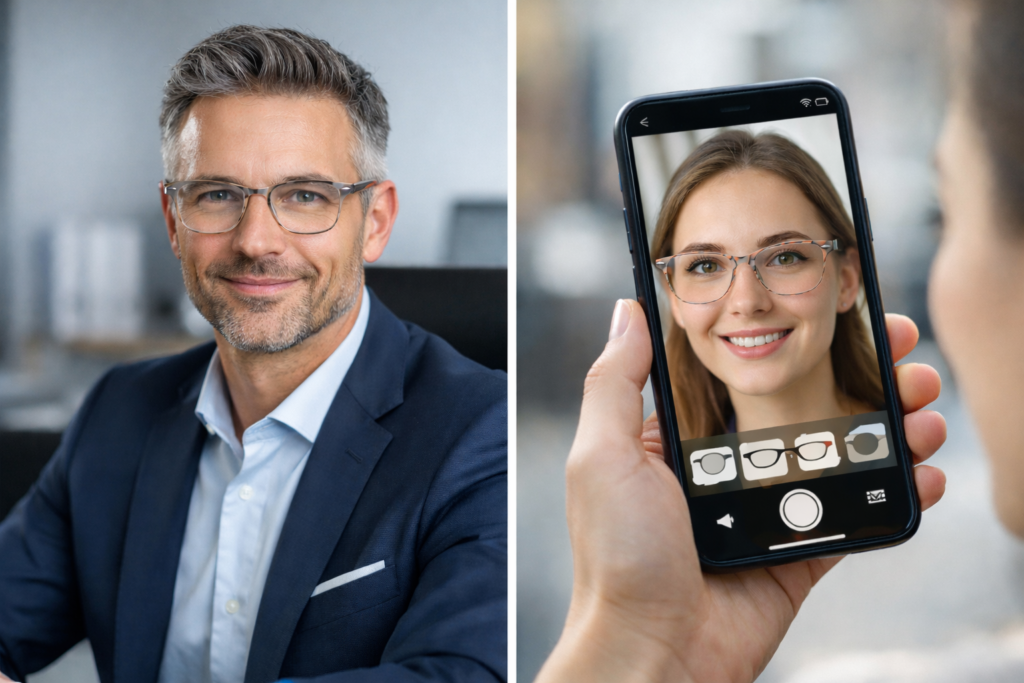
Professional eyewear virtual try-on using AI and augmented reality technology

Virtual Try-On vs Face Measurement: What Each One Solves

Virtual try-on shows you how a frame looks, not how it fits. Those are different problems. Try-on solves the aesthetic question well and the dimensional question poorly, which is why the more useful technology is facial measurement — it produces numbers you can check against a frame’s published dimensions.

Key takeaways

  • Try-on answers “does this suit me”. Measurement answers “will this fit me”. You need both.
  • Most try-on tools track your face in real time and overlay a 3D frame model. Quality depends on the model, not the camera.
  • Pupillary distance is the measurement that matters most and the one most often missing from a prescription.
  • Try-on cannot tell you about bridge contact, temple pressure or weight — the things that decide comfort at hour ten.
  • The strongest signal of a trustworthy retailer is published frame dimensions in millimetres, with or without try-on.

How does virtual try-on actually work?

A try-on tool does three things in sequence. It detects your face in the camera feed and locates landmarks — pupils, nose bridge, ears, jaw. It estimates the pose and scale of your head in three dimensions. It then renders a 3D model of the frame anchored to those landmarks, updating as you move.

The quality of the result depends far more on the frame model than on the face tracking. Face tracking is a mature, largely solved problem. Frame models are not: a retailer using generic frame shapes rather than accurately scanned models of its actual products will show you something that resembles the frame without being it. This is why try-on quality varies so widely between retailers using broadly similar underlying technology.

What virtual try-on is genuinely good at

  • Shape and proportion at a glance. Whether a round frame suits your face is answered in seconds rather than by imagination.
  • Comparing several frames quickly. The real value is throughput — narrowing twenty candidates to three.
  • Colour and finish in context. Seeing a bronze frame against your own skin is far more informative than a product photograph.
  • Removing the stock-model problem. Product images show frames on faces selected to flatter them. Your face is the only relevant test.
  • Reducing the intimidation of buying online. For a first-time online buyer this is not a small thing.

What it cannot tell you

This is the part retailers tend to skip, and it matters because it is where returns come from.

Bridge contact. Whether a frame rests evenly across the bridge of your nose or contacts at only two points determines whether it leaves marks by mid-afternoon. No camera-based overlay can assess this.

Temple pressure. Whether the arms grip behind your ears or slide forward depends on head width and ear position relative to temple length. A rendered overlay has no contact model.

Weight and balance. A frame can look correct and still feel front-heavy. Weight distribution is a physical property that no visualisation conveys.

Scale accuracy. Without a reference object of known size, monocular scale estimation is approximate. A frame can appear well-proportioned in try-on and arrive noticeably larger or smaller.

These four are precisely the variables that decide comfort across a long working day, which is why try-on alone does not solve the return-rate problem in online eyewear.

Why measurement matters more than visualisation

Facial measurement tools address the gap. Rather than rendering a frame on your face, they measure your face and give you numbers — pupillary distance, and in better implementations the facial widths that map onto frame dimensions.

Pupillary distance is the gap in millimetres between the centres of your pupils. It determines where the optical centre of each lens sits. Get it wrong and a technically correct prescription can still feel subtly off — a vague eye strain that people usually blame on the prescription itself. It is a fitting measurement rather than a clinical one, which is why most opticians leave it off the prescription sheet entirely.

Once you have your PD and a frame’s published dimensions, you can compare directly against a pair that already fits you. Look inside the temple arm of your current glasses and you will find something like 52-18-140: lens width, bridge width and temple length in millimetres. Those three numbers tell you more about whether a frame will work than any visualisation.

How to use these tools well

  1. Use try-on first, to narrow the field. Twenty candidates to three, on shape and colour.
  2. Measure your PD with a digital tool, or ask your optician for it. Do not accept an average.
  3. Read the dimensions off a pair that already fits you from the inside of the temple arm.
  4. Compare those numbers against the published dimensions of your three candidates. Discard anything far outside your baseline.
  5. Check the returns policy covers change of mind, not only defects. Even with good tools, fit is not guaranteed first time.
  6. Confirm there is a route to adjustment after purchase. Almost every frame needs a small adjustment eventually.

Does this technology actually reduce returns?

Partly, and honesty about the limits is warranted. Try-on demonstrably helps with the aesthetic dimension of returns — the “it does not suit me” category — because it lets people reject frames before buying rather than after. It does considerably less for the fit dimension, because it does not measure fit.

The combination is what works: visualisation to choose, measurement to verify, and a returns policy honest enough to cover the residual. Any retailer presenting try-on alone as a complete solution to buying eyewear online is overstating what the technology does.

What OpteLux provides

The VisionCraft Center is built around this split. The AI and VR suggestion tool handles visualisation — showing frames on your own face across different environments rather than on a stock model. The face and PD measurement tool handles the dimensional side, producing the numbers you need to compare against published specifications. Both are free to use before ordering.

Frame dimensions are published in millimetres on every product page, which is the part that makes the measurement useful. Returns run for 30 days from delivery in like-new condition with the original case and cloth.

Frequently asked questions

Is virtual try-on accurate?
Accurate for shape, colour and rough proportion. Approximate for absolute scale, and not informative at all about contact points, pressure or weight.

Can I measure my PD without a digital tool?
Yes — a millimetre ruler and a mirror will get you close in about a minute. Ask your optician if you want it confirmed. Do not use an average figure.

Does try-on work on a phone?
Generally better than on a laptop. Phone front cameras and their depth sensing are usually superior to built-in webcams.

Do I still need to try frames on in person?
Not necessarily, provided you have your PD, the frame’s published dimensions, and a returns policy that covers change of mind.

Why is PD missing from my prescription?
Because it is a fitting measurement rather than a clinical one. You are entitled to ask for it.

Does try-on work with strong prescriptions?
It shows the frame accurately but not the lens thickness that a strong prescription produces. Ask about lens index for high prescriptions.

The short version

Use try-on to decide what suits you and measurement to decide what fits you. The first is a visualisation problem and largely solved; the second is a dimensional problem and solved by numbers, not pictures. A retailer that publishes frame dimensions and gives you your PD is giving you more than one that offers only a slick overlay.

Try both tools at the VisionCraft Center. Grade-A titanium frames from $210, with 25% off the first order for new accounts.

Related reading

Leave a Reply

Your email address will not be published. Required fields are marked *