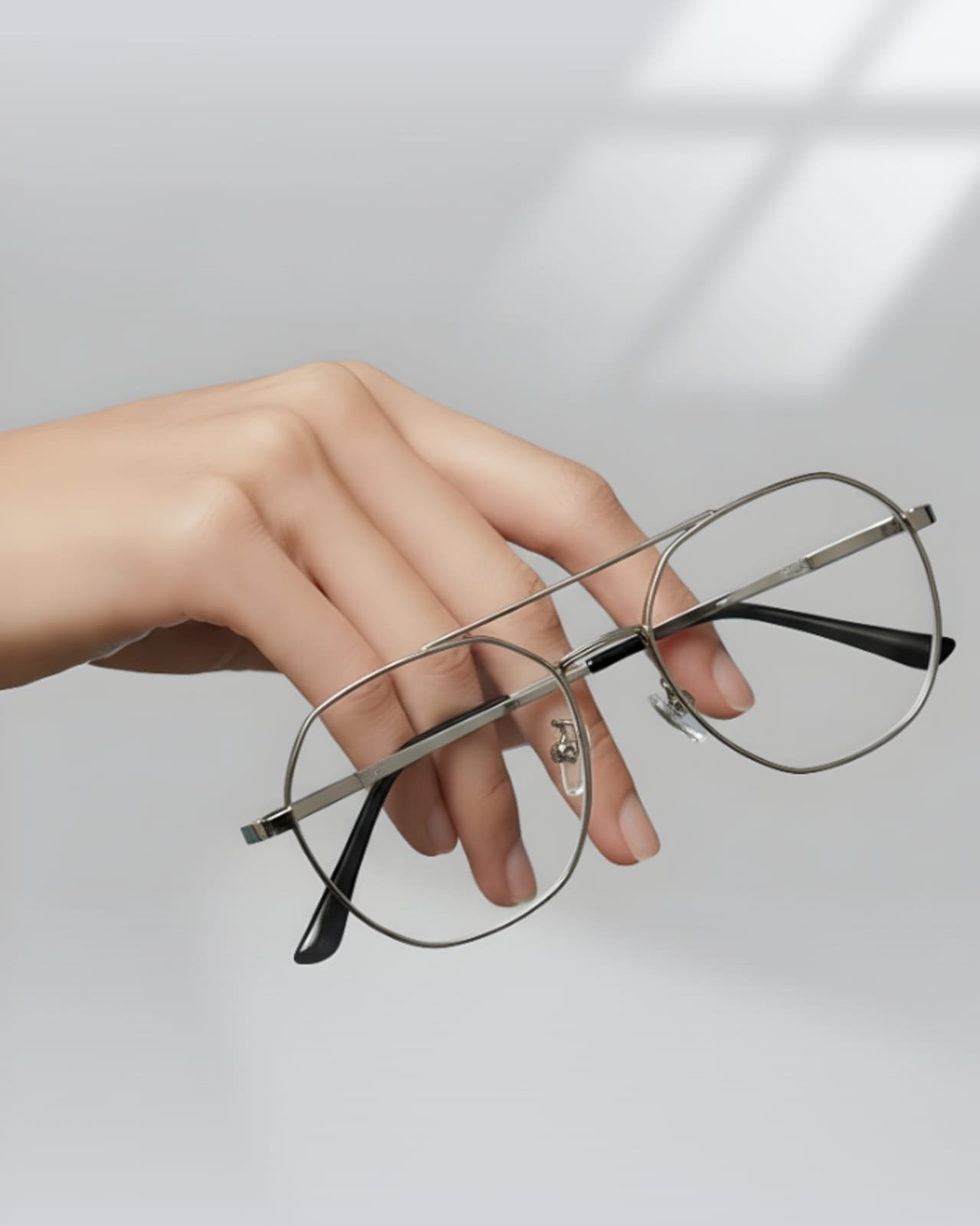




How Eyewear Reads in Professional Settings

In professional settings, eyewear is read before it is noticed. Proportion and finish do most of the work: a frame that matches the width of your face and sits level reads as deliberate, while one that is too wide, too heavy or slightly crooked reads as careless — regardless of what it cost.

Key takeaways

  • Fit signals more than brand. A well-fitted inexpensive frame reads better than an expensive one sitting badly.
  • Frame width should end roughly where your face does. Overhang is the most common and most visible error.
  • Thin profiles read as senior. Heavy frames read as creative or casual, which may or may not be what you want.
  • Consistency matters: one frame worn daily reads as considered; rotating between very different frames reads as indecisive.
  • On video, eyewear occupies a far larger share of the frame than in person. Choose for the camera if you live on calls.

Why does eyewear carry so much signal at work?

Attention in conversation goes to the eyes. Anything sitting on or near them is in the highest-attention region of your face for the entire time you are speaking. Unlike a watch or a bag, eyewear cannot be put away, and unlike clothing it does not change day to day. Whatever it communicates, it communicates constantly.

That is not an argument for spending more. It is an argument for spending attention. The variables that carry signal — fit, proportion, finish, alignment — are mostly free. They are decisions, not purchases.

What does proportion actually mean here?

Three measurements govern how a frame reads, and all three are printed inside the temple arm of any pair that already fits you, in the form 52-18-140.

Measurement What it is How it reads when wrong
Lens width (52) Width of one lens in millimetres Too wide and the frame overhangs the face, which reads as borrowed
Bridge width (18) Gap between the lenses Too narrow and the frame rides high; too wide and it slides
Temple length (140) Length of the arm Too short grips behind the ear; too long slides forward all day

Overall frame width is the one people notice without being able to name. The frame should end at roughly the widest point of your face. Extending past it makes the face look narrower and the frame look oversized; stopping well short makes the face look wider. This single relationship does more for how a frame reads than shape, colour or brand.

Thin or bold — what does each communicate?

Frame weight in the visual sense, meaning how much material is visible, is the strongest style signal after proportion.

Thin metal frames — rimless, semi-rimless and fine wire profiles — recede. They leave the face dominant and read as understated and senior. They are the conservative choice in finance, law and executive settings, and they photograph well because there is little frame to render.

Medium profiles in metal or thin acetate are the broad middle ground. Visible enough to be a deliberate choice, restrained enough not to dominate. This is where most professional eyewear sits and where it is hardest to get wrong.

Bold acetate frames read as creative, confident and contemporary. In design, media, architecture and technology they signal fluency. In more conservative sectors they read as a statement, which is fine if intended and a liability if not.

None of these is better. The error is mismatch — a bold frame in a room where restraint is the currency, or a barely-there rimless frame in a creative studio where personality is expected.

How does eyewear read on video?

Video changed the calculation, and most advice has not caught up. On a webcam your face occupies a small rectangle, and eyewear occupies a much larger proportion of it than in person. A frame that is understated across a meeting table can dominate on a call.

Three practical adjustments. First, favour lighter and thinner profiles if most of your meetings are remote. Second, prefer brushed or matte finishes, because polished metal produces bright highlights along the top rim under single-source lighting — those read as distracting white lines on camera. Third, anti-reflective coating stops being cosmetic and becomes functional: without it, your screen reflects in your lenses and your eyes disappear behind two bright rectangles, which removes the eye contact the whole call depends on.

Does alignment really matter that much?

More than almost anything else, and it is the most commonly neglected. A frame sitting even slightly crooked is immediately visible to everyone you speak to and invisible to you, because you see it from behind.

Misalignment accumulates rather than happening at once. Removing glasses one-handed pulls asymmetrically on one temple; over months that becomes a permanent set. Resting them on top of your head stretches the temples wider than your face. Both are habits rather than accidents, and both are reversible with a professional adjustment that takes minutes.

The practical rule: have the fit checked roughly every six months, and take the frame off and look at it straight on from time to time. If one lens sits lower than the other, it is not your imagination.

How many frames should a professional own?

One that fits properly, worn consistently, beats three that fit approximately. Consistency reads as a settled decision; frequent switching between very different frames reads as unresolved.

Where a second pair earns its place is function rather than variety — sunglasses, or a spare with an up-to-date prescription for travel. A magnetic or titanium clip-on solves the outdoor problem without a second frame at all, which is why it suits people who travel frequently and would rather carry one case.

Choosing well without overthinking it

  1. Start with measurements, not shapes. Read 52-18-140 from a pair that already fits and use it as your baseline.
  2. Set the profile to your sector. Thin and restrained for conservative environments, medium for most, bold where personality is currency.
  3. Choose the finish for your lighting. Brushed or matte if you are on camera or under office lighting.
  4. Match the metal tone to your skin undertone rather than to your clothes.
  5. Insist on anti-reflective coating. On video it is the difference between eye contact and two bright rectangles.
  6. Book the adjustment. A frame that fits is worth more than a frame that impresses.

Where the specification actually helps

Almost everything above is about fit rather than cost, but material does carry through into how a frame reads over time. Frames worn ten or more hours a day take punishment, and one that has corroded at the contact points or lost its shape stops reading as considered no matter how well it was chosen.

This is the practical case for Grade-A titanium: it does not corrode in contact with sweat or skin oils, it flexes and returns rather than taking a permanent set, and its strength-to-weight ratio allows the thin profiles that read best in professional settings without the frame becoming fragile. As a material category, titanium frames commonly fall around 8 to 15 grams against roughly 20 to 35 for comparable acetate, though the figure that matters is the one published for the specific model.

OpteLux publishes frame dimensions in millimetres on every product page, and the face and PD measurement tool at the VisionCraft Center is free to use before ordering — which removes the guesswork from the one variable that matters most.

Frequently asked questions

Do glasses make you look more competent?
There is a persistent cultural association, but it is weak and context-dependent. Fit and alignment carry far more signal than the presence of glasses.

Are rimless frames too conservative?
They read as understated rather than dated, particularly in titanium. If you want the face dominant, that is exactly the point.

Should frames match my watch metal?
It is a small refinement, not a rule. Keeping the metal temperature consistent — both warm or both cool — is enough.

Is it acceptable to wear bold frames in a conservative office?
Yes, if worn consistently and fitted properly. What reads badly is a bold frame that also fits poorly.

How often should frames be replaced?
Lenses every two to three years as prescriptions change. A well-made titanium frame should outlast several sets of lenses.

Does anti-reflective coating make a visible difference on calls?
Yes, and it is the single most noticeable improvement most people can make to how they appear on video.

The short version

Fit, proportion, finish and alignment carry nearly all the signal. Get the width right, keep the frame level, choose a finish suited to your lighting, and wear one pair consistently. Those four decisions cost nothing and matter more than the label.

Explore the OpteLux collection in Grade-A titanium, from $210, with dimensions published on every product page. New accounts receive 25% off the first order.

Related reading

Leave a Reply

Your email address will not be published. Required fields are marked *